Jiva Rhythm
Barnyard Millet
Barnyard Millet
Couldn't load pickup availability
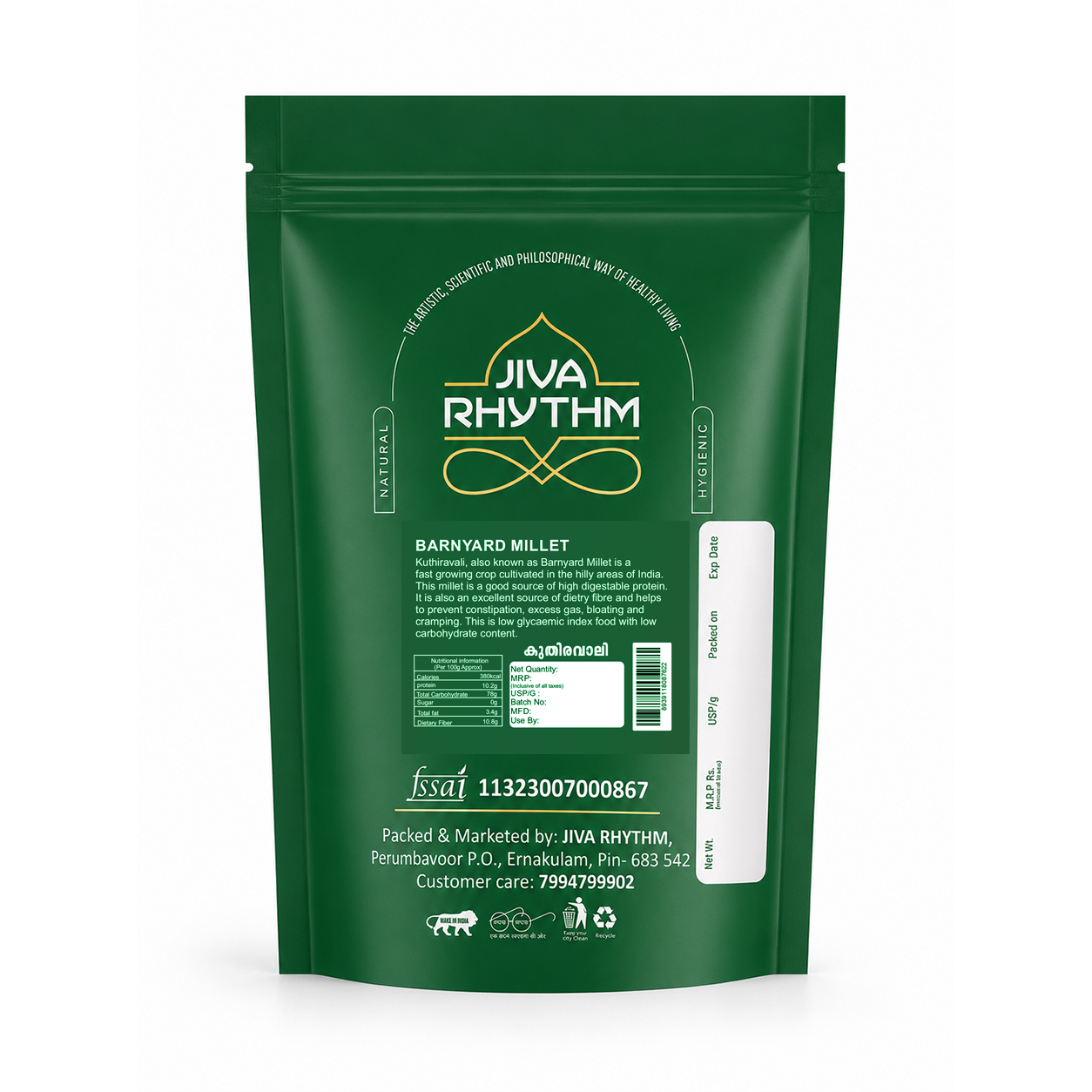
Barnyard millet (Echinochloa frumentacea) is a highly resilient ancient grain primarily grown in the hilly regions of India. Known by several regional names—including Kuthiravali in Tamil, Oodalu in Telugu, Jhangora in Hindi, and Kavadapullu in Malayalam—it is the unsung hero of the millet family.
The grain is small, ivory-white, and round, cooking into a remarkably light, fluffy texture with a mild, earthy flavor. Agronomically, it is a robust, fast-growing crop requiring very little water. Culturally, it is widely recognized as a premium fasting grain (vrat ka chawal) across India because it is not botanically classified as a cereal grain, providing clean, easily digestible energy during religious fasting periods.
NUTRITlON INFO
NUTRITlON INFO
Approximate nutritional breakdown per 100-gram serving of cooked barnyard millet:
Calories~105 - 115 kcal
Carbohydrates~21g - 23g
Protein~2.5g - 3.2g
Dietary Fiber~2.4g - 3.2g
Fat~0.6g - 0.9g
Glycemic Index (GI)Exceptionally Low (~41)
USAGE/RECIPE
USAGE/RECIPE
Barnyard millet is highly versatile and beginner-friendly, cooking much faster than coarser millets like sorghum or pearl millet.
💡 Preparation Tips
- Rinsing: Wash the grains thoroughly 2 to 3 times to remove surface impurities.
- Soaking: While it can cook unsoaked, soaking the millet for 1 to 2 hours (or at least 30 minutes) softens the grain core, optimizes nutrient bioavailability, and shortens the cooking process.
Primary Cooking Ratios
Standard Fluffy Ratio: 1 cup of raw barnyard millet to 2 to 2.5 cups of water.
- Stovetop (Rice-Style): Bring water to a boil, stir in the soaked millet, cover with a tight lid, and simmer on a low flame for 10 to 15 minutes until the water is completely absorbed. Let it rest covered off the heat for 5 minutes before fluffing with a fork.
- Pressure Cooker: Cook for 2 to 3 whistles on medium heat for quick, uniform results.
Culinary Applications
- Perfect Rice Substitute: Because it mimics the texture of small-grain rice, it pairs perfectly as a direct daily table alternative for traditional dals, fish curries, and vegetable stir-fries.
- Tiffin Batters & Porridges: It is excellent for grinding and blending with urad dal to make light, digestible Idlis and crispy Dosas, or boiled with vegetables for a comforting Upma.
- Khichdi & One-Pot Meals: Toss it with split yellow moong dal, ginger, and mixed seasonal vegetables for a comforting, easy-to-digest therapeutic meal.
- Infant Food & Convalescence Gruel: Cooked down with excess water or milk, it forms a highly smooth, nutritional gruel (Kanji or Kheer) that is gentle enough for infants (6+ months) and recovering individuals.
SHIPPING
SHIPPING
Share Link