Jiva Rhythm
Horse gram
Horse gram
Couldn't load pickup availability
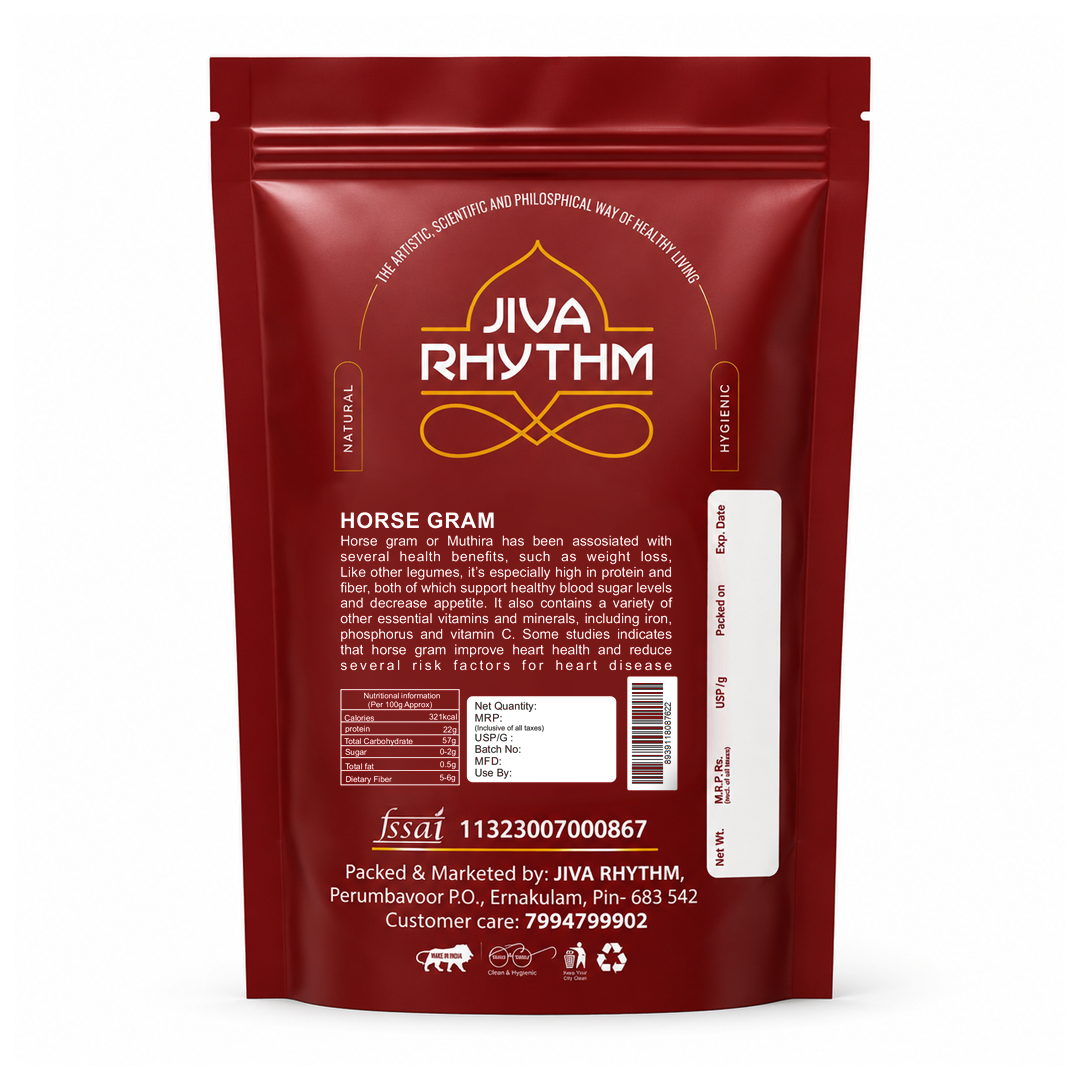
Horse gram (Macrotyloma uniflorum), widely celebrated across India as a therapeutic superfood, is one of the most resilient and nutrient-dense legumes on earth. Known as Muthira in Malayalam, Kollu in Tamil, Hurali in Kannada, Ulavalu in Telugu, and Kulthi in Hindi, it has been an integral part of traditional agricultural and dietary systems for millennia.
The unpolished grains are small, flattened, and oval-shaped, sporting a distinct deep reddish-brown, iron-clay, or mottled grey color. When cooked, horse gram develops a distinctly robust, deeply earthy, and smoky flavor profile with a firm, hearty texture. Historically praised for providing stamina, it was the primary grain used to feed high-performance racehorses (hence its English name). Agronomically, it is a climate-defying crop that excels in severe drought conditions and poor, rocky soils where other legumes fail completely.
NUTRITlON INFO
NUTRITlON INFO
Approximate nutritional breakdown per 100-gram serving of cooked horse gram:
Calories~120 - 135 kcal
Carbohydrates~21g - 24g
Protein~7.0g - 8.2g
Dietary Fiber~4.5g - 5.2g
Fat~0.3g - 0.5g
Glycemic Index (GI)Exceptionally Low (~25 - 30)
USAGE/RECIPE
USAGE/RECIPE
Because horse gram possesses an incredibly tough, rigid outer seed coat, it demands a mandatory, disciplined soaking window to break down anti-nutrients and guarantee a tender, digestible texture.
💡 Preparation Tips
- Rinsing: Wash the flat grains thoroughly 2 to 3 times in cool water to clear away any surface dust or sediment.
- Mandatory Long Soaking: Soak horse gram in water for at least 8 to 12 hours (ideally overnight) before introducing heat. This neutralizes phytic acid (unlocking maximum iron and calcium bioavailability) and drastically cuts down cooking times.
- Sprouting (Highly Recommended): To take its nutritional profile to the absolute peak, drain the soaked grains and wrap them in a damp cotton cloth for 24 hours to sprout. Sprouting multiplies its vitamin C content, significantly eases digestion, and vastly improves the bioavailability of its mineral payload.
Primary Cooking Ratios
Standard Cooking Ratio: 1 cup of raw, soaked horse gram to 3 to 3.5 cups of water.
- Pressure Cooker (Highly Recommended): Due to its incredibly dense structure, cooking in a pressure cooker is best. Add the soaked grains, water, and a pinch of salt, and cook for 6 to 8 whistles on medium heat until the grain core is thoroughly softened and buttery.
- Stovetop Simmer: Bring water to a roaring boil, add soaked grains, cover tightly, and drop heat to low. Simmer patiently for 60 to 75 minutes.
Popular Culinary Applications
- Traditional South Indian Muthira Kanji (Porridge): A comforting, deeply therapeutic dish popular in Kerala during the monsoon season. Whole horse gram is pressure-cooked along with unpolished broken brown rice until thoroughly soft, then mixed with fresh grated coconut and a pinch of salt. It serves as an incredible body-warming, stamina-boosting breakfast.
- Medicinal Kollu Rasam (Spiced Soup): A legendary, tangy Tamil Nadu style medicinal soup. The nutrient-dense water strained after boiling the horse gram is simmered with tamarind juice, crushed black pepper, cumin seeds, garlic, mustard seeds, and curry leaves. It is consumed warm like a broth to clear up severe colds, fevers, and asthma symptoms.
- Protein-Rich Thoran / Chammanthi (Dry Stir-Fry / Chutney): Boiled horse gram can be tossed with mustard seeds, shallots, green chilies, and a mountain of fresh grated coconut to make a dry side dish (Thoran). Alternatively, roasted horse gram can be ground with dry red chilies, tamarind, garlic, and coconut into a thick, rustic chutney (Chammanthi) to pair with rice or millets.
- Traditional Andhra Ulavacharu: A thick, deeply flavorful, slow-cooked horse gram soup or stew from Andhra Pradesh. It is painstakingly simmered for hours to concentrate its earthy, smoky flavors and is traditionally served hot over steaming white or brown rice with a dollop of fresh cream or ghee.
SHIPPING
SHIPPING
Share Link