Jiva Rhythm
Kodo Millet
Kodo Millet
Couldn't load pickup availability
Kodo millet (Paspalum scrobiculatum) is an exceptionally hardy, drought-resistant ancient grain that has been cultivated across the Indian subcontinent for thousands of years. Heavily integrated into traditional farming systems, it is widely recognized by its regional names: Koovaragu in Malayalam, Varagu in Tamil, Arka in Kannada, Arikelu in Telugu, and Kodo in Hindi.
The unpolished grain ranges from light brown to dark grey and features a tough, multi-layered seed coat that protects its dense inner nutrients. Once cooked, it yields a separate, fluffy, and light consistency with a uniquely rustic, earthy, and slightly nutty flavor. Agronomically, it thrives in poor soils where other crops fail, making it a sustainable superfood.
NUTRITlON INFO
NUTRITlON INFO
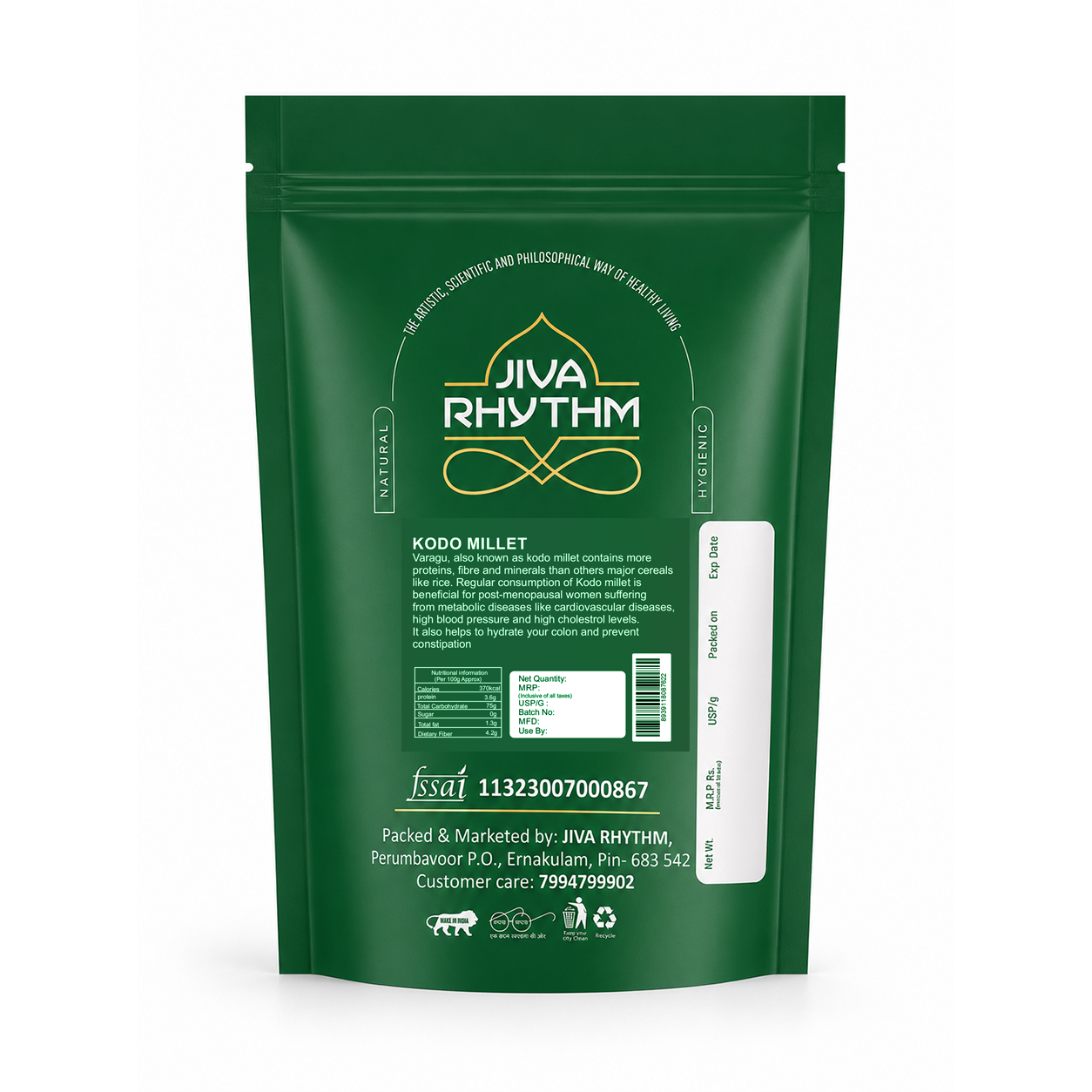
Approximate nutritional breakdown per 100-gram serving of cooked Kodo millet:
Calories~110 - 125 kcal
Carbohydrates~22g - 24g
Protein~2.6g - 3.2g
Dietary Fiber~2.2g - 2.8g
Fat~0.4g - 0.6g
Glycemic Index (GI)Exceptionally Low (~50)
USAGE/RECIPE
USAGE/RECIPE
Because Kodo millet possesses a hardy outer bran layer, it requires a mandatory, structured soaking window to neutralize phytic inhibitors, optimize mineral absorption, and ensure a tender texture.
💡 Preparation Tips
- Rinsing: Wash the grains thoroughly 2 to 3 times in a fine-mesh strainer to remove surface impurities.
- Mandatory Soaking: Soak the millet in water for at least 4 to 6 hours before introducing heat. This drastically cuts down cooking time and ensures the core cooks through evenly.
Primary Cooking Ratios
Standard Fluffy Ratio (Rice Alternative): 1 cup of raw, soaked Kodo millet to 2.25 to 2.5 cups of water.
- Stovetop (Absorption Method): Bring water to a roaring boil, stir in the soaked grains, cover tightly with a lid, and drop the flame to low. Simmer patiently for 12 to 15 minutes until the water is completely absorbed. Turn off the flame and let it steam undisturbed for 5 minutes before fluffing gently with a fork.
- Pressure Cooker: Cook for 2 whistles on medium-low heat to ensure the grain core is thoroughly softened.
Culinary Applications
- The Perfect Daily Rice Swap: Because it mimics the texture of small-grain rice, it serves as a direct, nutrient-dense replacement for white table rice. Pair it alongside traditional daily lentil dals, vegetable thorans, sambar, or aromatic curries.
- Healthy Breakfast Upma or Pongal: Sauté the soaked grain with mustard seeds, curry leaves, crushed ginger, green chilies, and mixed seasonal vegetables for a clean, filling breakfast.
- Earthy Tiffin Batters: Swap out the standard parboiled white rice portion in your household breakfast recipes with whole Kodo millet. When ground and fermented alongside urad dal, it produces wonderfully light Idlis and ultra-crispy Dosas.
- Therapeutic Kanji (Porridge): Boil the grain with excess water, crushed garlic, and cumin seeds to form a smooth, comforting porridge—extensively used in traditional recovery diets to rebuild physical stamina.
SHIPPING
SHIPPING
Share Link