Jiva Rhythm
Kodo puttu podi
Kodo puttu podi
Couldn't load pickup availability
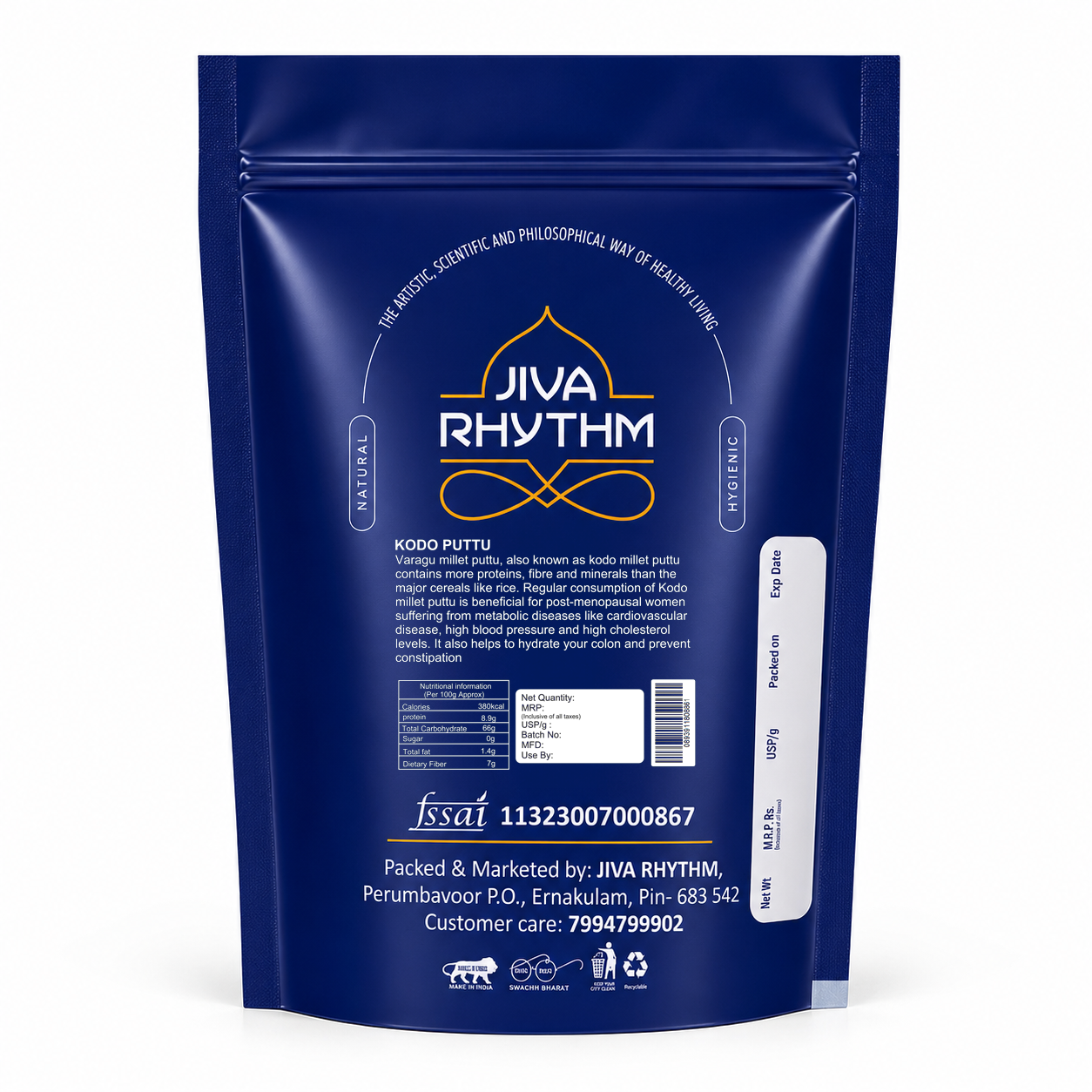
Kodo Puttu Podi is a premium, coarsely ground whole-grain flour made from Kodo Millet—historically celebrated as Varagu in Tamil, Koovaragu or Varaku in Malayalam, Arka in Kannada, Arikelu in Telugu, and Kodon in Hindi. This specialized flour is meticulously dry-roasted and textured specifically to prepare Puttu, the traditional layered steamed breakfast cake of South India.
The flour exhibits a subtle, earthy, light brown-to-tan hue because it is milled from unpolished grains, preserving the natural bran layer. When steamed, it delivers a deeply rustic, nutty flavor profile with a robust, satisfying texture. Agronomically, Kodo millet is an exceptional, climate-resilient crop that originated in India thousands of years ago, highly revered for its ability to thrive in extremely poor, drought-prone soils.
NUTRITlON INFO
NUTRITlON INFO
Approximate nutritional breakdown per 100-gram serving of steamed Kodo Puttu:
Calories~120 - 130 kcal
Carbohydrates~23g - 25g
Protein~2.5g - 3.0g
Dietary Fiber~2.8g - 3.5g
Fat~0.5g - 0.8g
Glycemic Index (GI)Exceptionally Low (~50)
USAGE/RECIPE
USAGE/RECIPE
Achieving a perfectly soft, fluffy Kodo Puttu rather than a dense or dry cake requires careful, progressive hydration to allow the whole-grain millet fibers to absorb moisture uniformly.
💡 The Perfect Kodo Puttu Recipe
1. Hydrating the Flour
- Take 1 cup of Kodo Puttu Podi in a wide mixing bowl and mix in a pinch of salt.
- Sprinkle room-temperature water very gradually (about $\frac{1}{3}$ to $\frac{1}{2}$ cup in total), rubbing the flour gently between your palms and fingertips.
- The Texture Test: Do not knead it into a dough. The mixture must remain moist but crumbly. When you squeeze a handful of the flour in your palm, it should easily form a soft lump, but crumble cleanly back into individual grains when tapped lightly.
- Cover the hydrated mixture and let it rest for 10 to 15 minutes to allow the rich millet fibers to absorb the moisture completely.
2. Layering & Steaming
- Take your Puttu Kutti (steaming tube) and drop the perforated disc into the bottom.
- Start with a thin layer of freshly grated coconut (1-2 tablespoons) at the base.
- Gently spoon in the moist Kodo flour until it reaches the halfway mark. Do not press, pack, or tamp down the flour tightly, or the steam will get blocked, leaving you with a dense, uncooked core.
- Add another thin layer of grated coconut, spoon in the remaining flour, and finish with a final layer of coconut at the top.
- Fix the tube securely onto your Puttu Kudam (pot) filled with boiling water.
- Steam on medium-high heat. Once steam begins to vent freely from the top lid, let it cook for an additional 6 to 8 minutes. You will know it is perfectly done when a rich, deeply rustic, roasted grain aroma fills the kitchen.
- Carefully push the steamed Puttu out from the bottom using a rod or skewer.
Popular Culinary Pairings
- The Complete Protein Match: Pair it hot with a spicy, deeply flavored Kadala Curry (black chickpeas simmered in a roasted coconut gravy) or a sprouted green gram curry. The combination of Kodo millet and pulses creates a complete, highly bioavailable plant-based protein profile.
- The Traditional Side: It pairs beautifully with everyday South Indian sides like a robust egg roast, chicken curry, or a simple, comforting lentil dal tempered with ghee and cumin seeds.
SHIPPING
SHIPPING
Share Link