Jiva Rhythm
Moth
Moth
Couldn't load pickup availability
Bengal Gram (Cicer arietinum), widely celebrated as Chana Dal when split and Kala Chana or Kadala in its whole black form, is one of the most foundational and ancient legumes cultivated in India. Known as Kadala in Malayalam, Kondakadle in Tamil, Kadale in Kannada, and Sanaga Pappu in Telugu, it is a dominant staple across South Asian cuisine.
The unpolished whole grain is small, hard, and dark brown to black with a rough coat. When de-hulled and split, it reveals a bright yellow, sweet, and nutty interior. It possesses a uniquely rich, earthy flavor profile and holds its structural shape exceptionally well during prolonged cooking. Agronomically, it functions as a natural nitrogen-fixing powerhouse, rejuvenating soil fertility wherever it is grown.
NUTRITlON INFO
NUTRITlON INFO
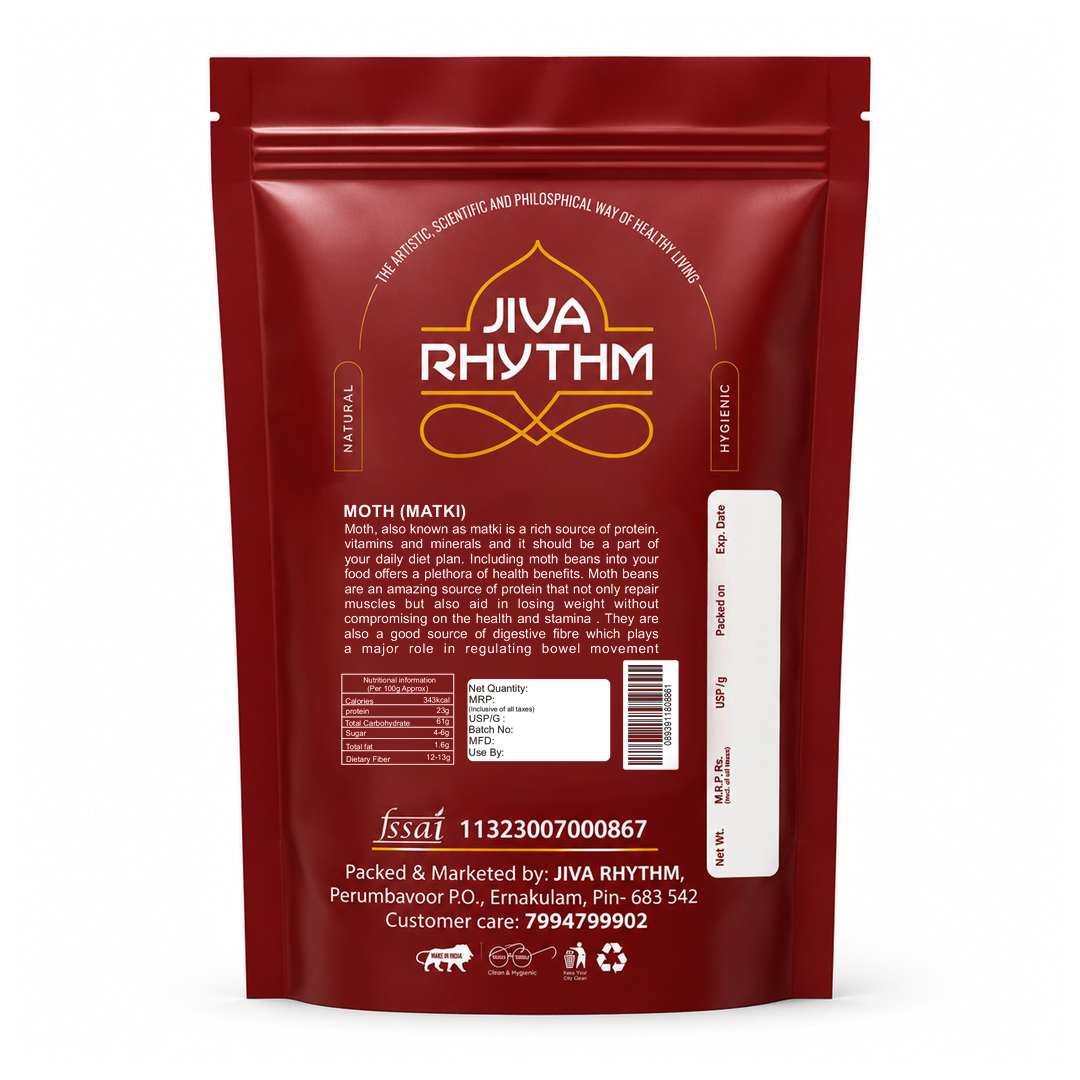
Approximate nutritional breakdown per 100-gram serving of cooked moth beans:
Calories~115 - 125 kcal
Carbohydrates~21g - 23g
Protein~6.5g - 7.5g
Dietary Fiber~4.0g - 4.8g
Fat~0.2g - 0.4g
Glycemic Index (GI)Exceptionally Low (~25 - 28)
USAGE/RECIPE
USAGE/RECIPE
Because moth beans are small and delicate compared to larger legumes like chickpeas or kidney beans, they cook relatively quickly but still benefit greatly from a structured soaking or sprouting window to maximize nutrient bioavailability.
💡 Preparation Tips
- Rinsing: Wash the tiny beans thoroughly 2 to 3 times in cool water to clear away any surface dust or ambient impurities.
- Soaking: Soak the beans in water for at least 4 to 6 hours before cooking. This neutralizes phytic acid (which can block mineral absorption) and ensures a perfectly uniform, tender texture.
- Sprouting (Highly Recommended): To unlock their absolute peak nutritional potential, soak them overnight, drain the water, and wrap them in a damp cotton cloth for 12 to 24 hours. Sprouting drastically multiplies their Vitamin C content, breaks down complex sugars to eliminate flatulence, and makes their iron and zinc highly bioavailable.
Primary Cooking Ratios
Standard Pluffy Ratio: 1 cup of raw, soaked moth beans to 2.5 cups of water.
- Stovetop Simmer: Bring water to a boil in a pot, add the soaked beans and a pinch of salt, cover tightly, and drop the heat to low. Simmer gently for 20 to 25 minutes until the beans are tender but hold their shape.
- Pressure Cooker: Cook for 2 to 3 whistles on medium heat for quick, perfectly soft results.
Culinary Applications
- Traditional Maharashtrian Matki Chi Usal: A legendary, deeply comforting regional dish. Sprouted moth beans are gently simmered in a spiced gravy infused with mustard seeds, curry leaves, ginger, garlic, onions, tomatoes, and a robust blend of Goda masala. It is traditionally served with flatbreads (rotis) or white rice.
- The Foundation for Misal Pav: Sprouted moth beans form the structural, high-protein base for the famous Misal—a spicy, aromatic curry topped with crunchy farsan, chopped onions, and a squeeze of fresh lemon, served alongside warm, buttered pav bread.
- Ultra-Clean Protein Salads: Simply steam sprouted moth beans for 5 minutes and toss them with finely diced cucumbers, tomatoes, onions, fresh coriander, green chilies, a dash of chaat masala, and a generous squeeze of lime juice for an incredibly refreshing, low-GI fat-loss snack.
- Daily Dal Alternative: Use split or whole moth beans to make a comforting daily lentil dal tempered with ghee, cumin seeds, asafoetida (hing), and turmeric, paired alongside brown rice or millets.
SHIPPING
SHIPPING
Share Link