Jiva Rhythm
Pearl Millet
Pearl Millet
Couldn't load pickup availability
Pearl millet (Pennisetum glaucum) is a robust, deeply nutrient-dense ancient grain that thrives in dry, high-temperature climates. Most famously known as Kambam in Malayalam, Kambu in Tamil, Sajje in Kannada, Sajjalu in Telugu, and Bajra in Hindi, it is one of the oldest cultivated crops in human history.
The grains are small, round, and feature a characteristic bluish-grey or light greenish color when unpolished. Pearl millet possesses a distinctively robust, nutty, and slightly sweet flavor with a dense texture. Because it has an intrinsically warming property (Ushna virya) in traditional dietary practices, it is heavily used to provide sustained energy, though it is equally celebrated in coastal regions as a fermented cooling summer beverage.
NUTRITlON INFO
NUTRITlON INFO
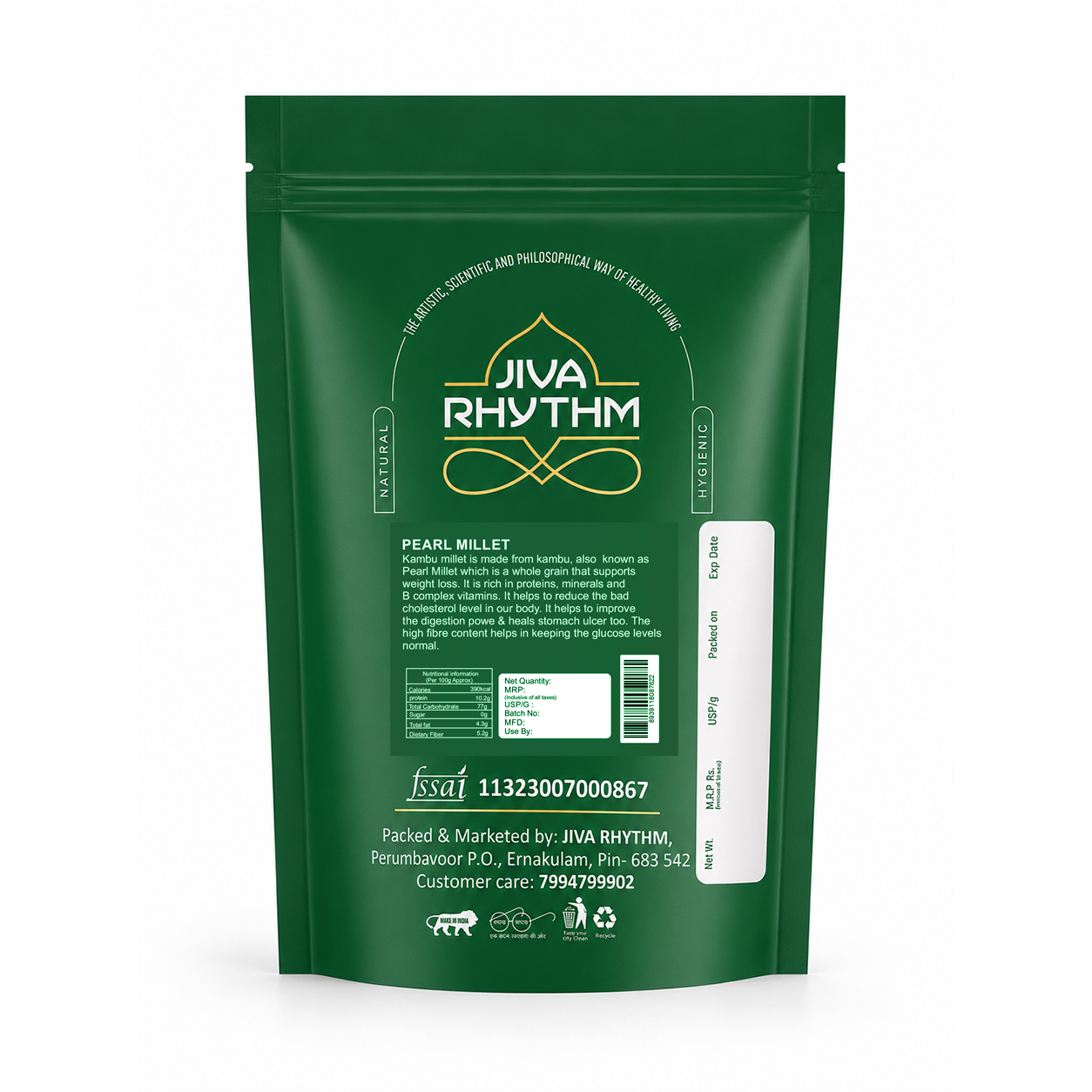
Approximate nutritional breakdown per 100-gram serving of cooked pearl millet:
Calories~115 - 135 kcal
Carbohydrates~23g - 26g
Protein~3.5g - 4.2g
Dietary Fiber~2.0g - 2.4g
Fat~1.3g - 1.7g
Glycemic Index (GI)Low (~54 - 55)
USAGE/RECIPE
USAGE/RECIPE
Because pearl millet grains have a firmer, denser structure than smaller millets like little or barnyard millet, they require structured preparation to soften thoroughly.
💡 Preparation Tips
- Rinsing: Wash the grains 2 to 3 times thoroughly under running water to clear away surface dust.
- Mandatory Soaking: To neutralize phytic acid (which can bind to its excellent iron and zinc content) and to ensure the core softens uniformly, soak whole pearl millet in water for at least 4 to 8 hours (ideally overnight) before cooking.
Primary Cooking Ratios
Standard Whole Grain Ratio: 1 cup of raw, soaked pearl millet to 3 cups of water or broth.
- Stovetop (Absorption Method): Bring water to a roaring boil, drop in the soaked grains, cover tightly with a lid, and drop the flame to low. Simmer patiently for 35 to 45 minutes until the grains are tender and chewable. Let it rest covered for 10 minutes off the heat.
- Pressure Cooker: Cook for 4 to 5 whistles on medium-low heat to ensure the hardy grain completely softens.
Popular Culinary Applications
- Kambam Koozh / Kambu Kanji (Traditional Summer Porridge): A legendary breakfast drink in Southern India. Whole pearl millet is broken or cooked down into a thick porridge, left to cool, and traditionally allowed to ferment overnight. The next morning, it is blended with fresh buttermilk, a pinch of salt, chopped shallots, and curry leaves. It acts as an incredibly potent natural body coolant and stamina booster.
- Pearl Millet Flour (Bajra Atta): The whole raw grain can be milled into a fine flour. Because it is gluten-free, it can be kneaded with warm water to press out incredibly hearty, rustic Rotis (flatbreads), or mixed with hot water to create traditional steamed Puttu.
- Fermented Breakfast Batters: You can swap out a major portion of parboiled white rice in your standard breakfast recipes for whole pearl millet. When ground and fermented with urad dal, it produces highly nutritious, earthy Idlis and crispy Dosas.
- Hearty Khichdi: Sauté broken pearl millet with yellow moong dal, a splash of ghee, ginger, cumin, and seasonal vegetables in a pressure cooker for a comforting, easily digestible, and deeply warming winter meal.
SHIPPING
SHIPPING
Share Link